Nesting of seven species of Charadriiformes in an inland artificial reservoir in Nuevo León, Mexico
DOI:
https://doi.org/10.28947/hrmo.2026.27.1.870Keywords:
inland freshwater, Laridae, terns, snowy plover, shorebirdsAbstract
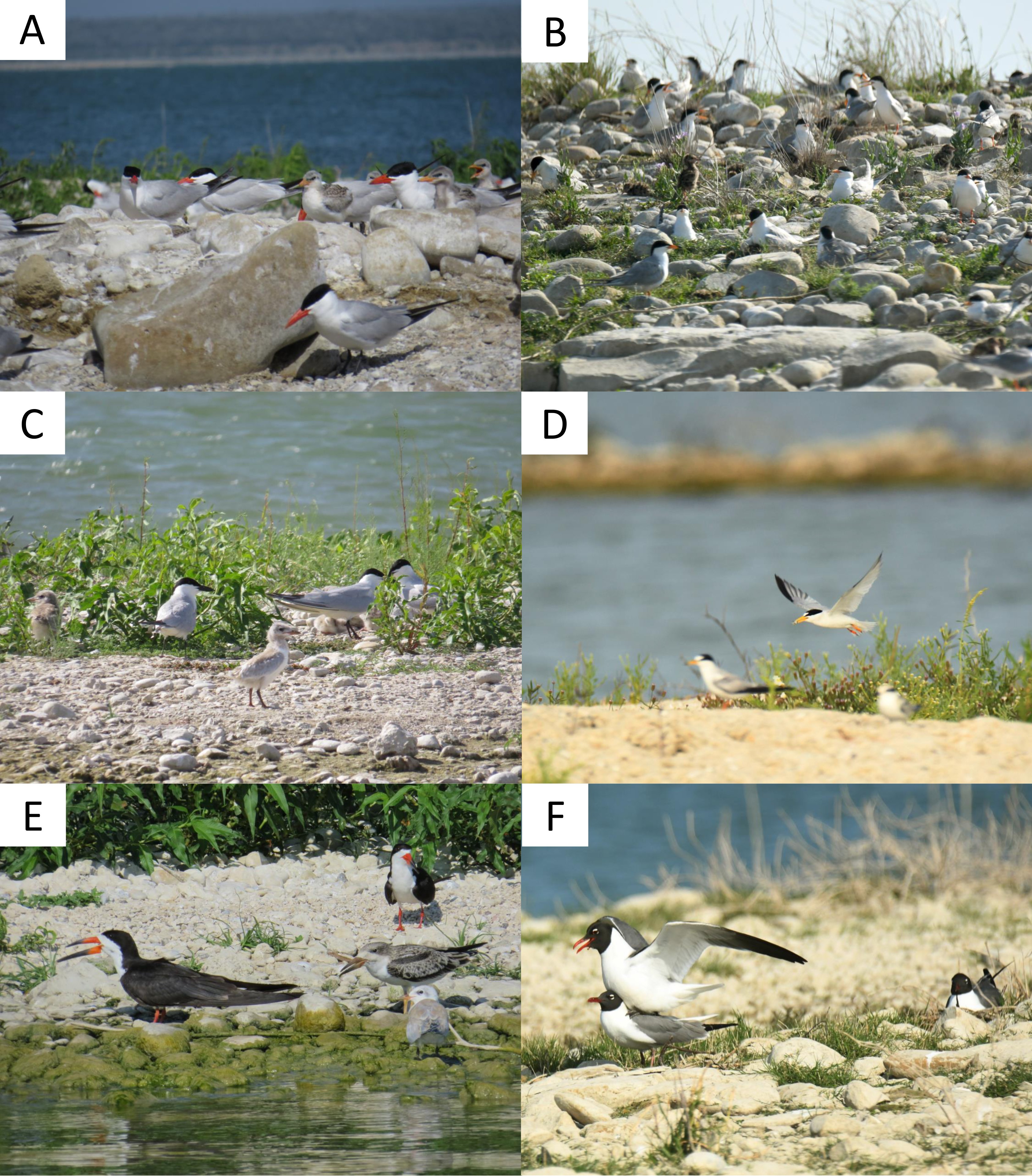
Limited information exists on nesting sites for Charadriiformes birds in the interior of northeastern Mexico, given that their breeding distribution is mostly confined to coastal areas. Over four breeding seasons (2018, 2023, 2024, and 2025), we surveyed three islands in the El Cuchillo-Solidaridad reservoir, Nuevo León, Mexico, to assess abundance of seven species of Charadriiformes: Least Tern Sternula antillarum, Gull-billed Tern Gelochelidon nilotica, Caspian Tern Hydroprogne caspia, Forster's Tern Sterna forsteri, Black Skimmer Rynchops niger, Laughing Gull Leucophaeus atricilla, and Snowy Plover Anarhynchus nivosus. We conducted counts of adults and juveniles from a catamaran between 07:00 and 10:00 h, dividing the islands into sectors and moving in a single direction to avoid double counting. We also obtained water volume data for the reservoir from official records of the Comisión Nacional del Agua. We documented breeding activity of these seven species for the first time in the state of Nuevo León, including the first nesting record of A. nivosus for northeastern Mexico. The most abundant species were G. nilotica, H. caspia, and R. niger, although the abundance of Charadriiformes varied among years. Total bird abundance showed a significant positive relationship with water volume, recording higher bird abundances in 2018 and 2025 when the reservoir exceeded 70% of storage capacity. In contrast, drought and reduced water levels in 2023–2024 led to population declines. Our results highlight the ecological value of inland artificial wetlands as key nesting sites for waterbirds.
Downloads
References
Álvarez Ruiz JA. 2016. eBird Checklist S31323864. eBird: An online database of bird distribution and abundance. Cornell Lab of Ornithology, Ithaca, New York. Disponible en: https://ebird.org/checklist/S31323864 (Consultado el 7 de junio de 2026).
Barbaree BA, Reiter ME, Hickey CM, Strum KM, Isola JE, Jennings S, Tarjan LM, Strong CM, Stenzel LE, Shuford WD. 2020. Effects of drought on the abundance and distribution of non-breeding shorebirds in central California, USA. PLoS ONE 15(10):e0240931. https://doi.org/10.1371/journal.pone.0240931.
Berumen Solórzano A, Maimone Celorio MR, Villordo Galván JA, Olivera Ávila CI, Gaspariano Martínez C, González Oreja JA. 2016. Nuevos registros de aves acuáticas en la Presa de Valsequillo, Puebla. Huitzil Revista Mexicana de Ornitología 17:139–144. https://doi.org/10.28947/hrmo.2016.17.1.226.
BirdLife International. 2020. Charadrius nivosus. The IUCN Red List of Threatened Species 2020: e.T22725033A181360276. https://doi.org/10.2305/IUCN.UK.2020-3.RLTS.T22725033A181360276.en. Consultado el 20 de agosto de 2025.
Brooke ML. 2001. Seabird systematics and distribution: A review of current knowledge. En Schreiber EA, Burger J (eds.). Biology of marine birds. CRC Press. https://doi.org/10.1201/9781420036305
Buckley PA, Buckley FG. 1980. Population and colony site trends of Long Island waterbirds for five years in the mid 1970s. Transactions of the Linnaean Society of New York 9:23–56.
Burger J. 1984. Abiotic factors affecting migrant shorebirds. Pp. 1–72. En Burger J, Olla BL (eds.). Shorebirds: migration and foraging behavior. Behavior of Marine Animals. Current Perspectives in Research vol. 6. New York, Plenum Press.
Carmona R, Danemann GD. 1998. Distribución espaciotemporal de aves playeras en Guerrero Negro, Baja California Sur, México. Ciencias Marinas 24:389–408.
Collias NE. 1997. On the origin and evolution of nest building by passerine birds. The Condor 99:253–270. https://doi.org/10.2307/1369932.
Colwell MA. 2010. Shorebird ecology, conservation, and management. University of California Press, USA.
CONAGUA (Comisión Nacional del Agua). 2020. Sistema Nacional de Información del Agua (SINA): Almacenamiento en presas principales de México. Secretaría de Medio Ambiente y Recursos Naturales, México. Disponible en: https://sinav30.conagua.gob.mx:8080/Presas/. (Consultado el 7 de junio de 2026).
CONAGUA (Comisión Nacional del Agua). 2024. Monitor de Sequía en México. Servicio Meteorológico Nacional, Secretaría de Medio Ambiente y Recursos Naturales, México. Disponible en: https://smn.conagua.gob.mx/es/climatologia/monitor-de-sequia/monitor-de-sequia-en-mexico. (Consultado el 7 de junio de 2026).
Croxall JP, Butchart SHM, Lascelles B, Stattersfield AJ, Sullivan B, Symes A, Taylor P. 2012. Seabird conservation status, threats and priority actions: a global assessment. Bird Conservation International 22:1–34. https://doi.org/10.1017/S0959270912000020.
Cruz-López M, Eberhart-Phillips LJ, Fernández G, Beamonte-Barrientos R, Székely T, Serrano-Meneses MA, Küpper C. 2017. The plight of a plover: viability of an important Snowy Plover population with flexible brood care in Mexico. Biological Conservation 209:440–448. https://doi.org/10.1016/j.biocon.2017.03.009.
Cuthbert FJ, Wires LR. 2020. Caspian Tern (Hydroprogne caspia), version 1.0. En Billerman SM (ed.). Birds of the World. Cornell Lab of Ornithology. Ithaca, NY. https://doi.org/10.2173/bow.caster1.01
DeSucre Medrano AE, Cervantes Zamudio O, Ramírez Bastida P, Gómez del Angel S. 2011. Notas sobre la biología reproductora del chorlo nevado (Charadrius nivosus) en el Lago de Texcoco, México. Huitzil Revista Mexicana de Ornitología 12:32–38. https://doi.org/10.28947/hrmo.2011.12.2.129.
Dorsey SS, Catlin DH, Ritter SJ, Wails CN, Robinson SG, Oliver KW, Bellman HA, Karpanty SM, Fraser JD. 2025. The importance of viewshed in nest site selection of a ground-nesting shorebird. PLoS ONE 20:e0319021. https://doi.org/10.1371/journal.pone.0319021.
del Hoyo J, Elliott A, Sargatal J. 1996. Handbook of the birds of the World, vol. 3: Hoatzin - Auks. Lynx Edicions, Barcelona.
Elphick CS. 2000. Functional equivalency between rice fields and seminatural wetland habitats. Conservation Biology 14:181–191. https://doi.org/10.1046/j.1523-1739.2000.98314.x
Freitas Rangel D, Freitas Nobre Da Silva E, Lopes Costa L. 2022. Occurrence and behaviour of shorebirds depend on food availability and distance of beaches from urban settlements. Acta Ornithologica 56:217–226. https://doi.org/10.3161/00016454AO2021.56.2.008
García E. 2004. Modificaciones al sistema de clasificación climática de Köppen. Instituto de Geografía, Universidad Nacional Autónoma de México. Ciudad de México, México.
Gómez de Silva H. 2005. Mexico. North American Birds 59:659–661.
Gómez del Ángel S, Palacios E, De Sucre Medrano AE. 2015. Forster's Tern (Sterna forsteri) breeding inland near Mexico City, Mexico. Waterbirds 38:427–430. https://doi.org/10.1675/063.038.0401 .
González-Rodríguez H, Ramírez-Lozano RG, Cantú-Silva I, Gómez-Meza MV, Uvalle-Sauceda JI. 2010. Composición y estructura de la vegetación en tres sitios del estado de Nuevo León, México. Polibotánica 29:91–106.
González Zuarth C, Vallarino A, Vázquez Botello A. 2016. Breeding biology of the Atlantic Least Tern (Sternula antillarum antillarum) in a colony of the south of the Gulf of Mexico: new perspectives for its threat status. Revista Brasileira de Ornitologia 24:323–328. https://doi.org/10.1007/BF03544361.
Hatfield J. 2025. eBird Checklist S220029940. eBird: An online database of bird distribution and abundance. Cornell Lab of Ornithology, Ithaca, New York. Disponible en: https://ebird.org/checklist/S220029940 (Consultado el 7 de junio de 2026).
Howell SNG, Webb S. 1995. A guide to the birds of Mexico and northern Central America. Oxford University Press, New York, NY, USA.
IUCN. 2025. The IUCN Red List of Threatened Species. Versión 2020-2. International Union for Conservation of Nature. Disponible en https://www.iucnredlist.org (Consultado el 10 de julio de 2025).
López A, Olvera A, Arrieta J. 2022. eBird Checklist S109128104. eBird: An online database of bird distribution and abundance. Cornell Lab of Ornithology, Ithaca, New York. Disponible en: https://ebird.org/checklist/S109128104 (Consultado el 7 de junio de 2026).
Luévano J, Mellink E, Riojas-López M. 2010. Plovers breeding in the highlands of Jalisco, Aguascalientes, Zacatecas, and San Luis Potosí, central Mexico. Western North American Naturalist 70:121–125. https://doi.org/10.3398/064.070.0114
Martin TE, Li P. 1992. Life history traits of open- vs. cavity-nesting birds. Ecology 73:579–592. https://doi.org/10.2307/1940764.
Martínez-Guerrero JH, Pereda-Solís ME, Vargas J, Salazar-Borunda M. 2023. Primer registro reproductivo del chorlo nevado (Charadrius nivosus) en Durango, México. Huitzil Revista Mexicana de Ornitología 24:e656. https://doi.org/10.28947/hrmo.2023.24.2.683
Mellink E, Riojas-López M. 2005. New breeding localities for the Snowy Plover in western Mexico. Western Birds 36:141–143.
Mellink E, Riojas-López M. 2006. Nesting of Forster's Tern in a tropical coastal lagoon, Cuyutlán, Colima, Mexico. Western Birds 37:45–47.
Mellink E, Riojas-López M, Luévano J. 2009. Breeding locations of seven Charadriiformes in coastal Southwestern Mexico. Waterbirds 32:44–53. https://doi.org/10.1675/063.032.0105
Molina KC. 1996. Population status and breeding biology of Black Skimmers at the Salton Sea, California. Western Birds 27:143–158.
Molina KC, Parnell JF, Erwin RM, Kirwan GM, García E. 2023. Gull-billed Tern (Gelochelidon nilotica), version 1.0. En Sly ND (ed.). Birds of the World. Cornell Lab of Ornithology. Ithaca: NY. https://doi.org/10.2173/bow.gubter2.01.
Monterrubio-Rico T, Cancino Murillo R, Pérez-Arteaga A, Lemus Ortiz E. 2020. Nueva localidad de reproducción para Charadrius nivosus en el centro de México. Huitzil Revista Mexicana de Ornitología 21:e576. https://doi.org/10.28947/hrmo.2020.21.1.453
Moreno-Contreras I, Mondaca F, Robles-Morales J, Jurado M, Cruz J, Alvidrez A, Robles-Carrillo J. 2016. New distributional and temporal bird records from Chihuahua, Mexico. Bulletin of the British Ornithologists’ Club 136:272–286.
Moreno Navarro J. 2011. Charrán Mínimo (Sternula antillarum). Observación de Naturalista ID: 1191042. iNaturalistMx CONABIO / iNaturalist Network. Disponible en: https://mexico.inaturalist.org/observations/1191042 (Consultado el 7 de junio de 2026).
Myers JP, Morrison RIG, Antas PZ, Harrington BA, Lovejoy TE, Sallaberry M, Senner SE, Tarak A. 1987. Conservation strategy for migratory species. American Scientist 75:19–26.
Nagarajan R, Thiyagesan K. 1996. Waterbirds and substrate quality of the Pichavaram wetlands, southern India. Ibis 138:710–721. https://doi.org/10.1111/j.1474-919X.1996.tb04773.x
Orozco Uribe LC. 2020. eBird Checklist S77512743. eBird: An online database of bird distribution and abundance. Cornell Lab of Ornithology, Ithaca, New York. Disponible en: https://ebird.org/checklist/S77512743 (Consultado el 7 de junio de 2026).
Page GW, Stenzel LE, Warriner JS, Warriner JC, Paton PW. 2023. Snowy Plover (Anarhynchus nivosus), version 1.1. En Poole AF (ed.). Birds of the world. Cornell Lab of Ornithology. Ithaca, NY. https://doi.org/10.2173/bow.snoplo5.01.1 .
Palacios E, Alfaro L. 1991. Breeding birds of Laguna Figueroa and La Pinta Pond, Baja California, Mexico. Western Birds 22:27–32.
Payne NF. 1992. Techniques for wildlife habitat management of wetlands. McGraw-Hill Inc. Nueva York, USA.
Piersma T, Lok T, Chen Y, Hassell CJ, Yang HY, Boyle A, Slaymaker M, Chan YC, Melville DS, Zhang ZW, Ma Z. 2016. Simultaneous declines in summer survival of three shorebird species signals a flyway at risk. Journal of Applied Ecology 53:479–490. https://doi.org/10.1111/1365-2664.12582
Pius SM, Leberg PL. 1998. The protector species hypothesis: Do Black Skimmers find refuge from predators in Gull-billed Tern colonies? Ethology 104:273–284. https://doi.org/10.1111/j.1439-0310.1998.tb00068.x
Quintero-Félix RS, González-Martín del Campo F, Contreras-Terrazas C, Sánchez-Hernández G. 2022. Anidación del chorlo nevado (Charadrius nivosus) en Atotonilco, Jalisco, México. Revista Peruana de Biología 29:e23131. https://doi.org/10.15381/rpb.v29i4.23131.
Santos E, Artigas Azas JM. 2019. eBird Checklist S59082333. eBird: An online database of bird distribution and abundance. Cornell Lab of Ornithology, Ithaca, New York. Disponible en: https://ebird.org/checklist/S59082333 (Consultado el 7 de junio de 2026).
Schippers P, Snep RPH, Schotman AGM, Jochem R, Stienen EWM, Slim PA. 2009. Seabird metapopulations: searching for alternative breeding habitats. Population Ecology 51:459–470. https://doi.org/10.1007/s10144-009-0159-z.
SECTUR (Secretaría de Turismo del Estado de Nuevo León). 2019. Programa Estratégico de Desarrollo Turístico Sostenible de Nuevo León. Gobierno del Estado de Nuevo León. México.
SEMARNAT (Secretaría de Medio Ambiente y Recursos Naturales). 2010. Norma Oficial Mexicana NOM-059-SEMARNAT-2010, Protección Ambiental – Especies nativas de México de flora y fauna silvestres – Categorías de riesgo y especificaciones para su inclusión, exclusión o cambio – lista de especies en riesgo. Diario Oficial de la Federación. 30 de diciembre de 2010, Segunda Sección. México, D.F.
Souza D. 2020. eBird Checklist S66286893. eBird: An online database of bird distribution and abundance. Cornell Lab of Ornithology, Ithaca, New York. Disponible en: https://ebird.org/checklist/S66286893 (Consultado el 7 de junio de 2026).
Stienen EWM, Brenninkmeijer A. 2002. Variation in growth in Sandwich Tern chicks Sterna sandvicensis and the consequences for pre- and post-fledging mortality. Ibis 144:567–576. https://doi.org/10.1046/j.1474-919X.2002.00086.x
Stienen EWM, Van Beers PWM, Brenninkmeijer A, Habraken JMPM, Raaijmakers MHJE, Van Tienen PGM. 2000. Reflections of a specialist: patterns in food provisioning and foraging conditions in sandwich terns Sterna sandvicensis. Ardea 88:33–49.
Studds CE, Kendall BE, Murray NJ, Wilson HB, Rogers DI, Clemens RS, Gosbell K, Hassell CJ, Jessop R, Melville DS, Milton DA, Minton CDT, Possingham HP, Riegen AC, Straw P, Woehler EJ, Fuller RA. 2017. Rapid population decline in migratory shorebirds relying on Yellow Sea tidal mudflats as stopover sites. Nature Communications 8:14895. https://doi.org/10.1038/ncomms14895
Thompson BC, Jackson JA, Burger J, Hill LA, Kirsch EM, Atwood JL. 2020. Least Tern (Sternula antillarum), version 1.0. En Poole AF, Gill FB (eds.). Birds of the World. Cornell Lab of Ornithology. Ithaca, NY. https://doi.org/10.2173/bow.leater1.01.
Torres-Morales M, Barajas-Martínez LA. 2011. Comunidad de peces de la presa El Cuchillo. Fondo Mixto CONACyT-Gobierno del Estado de Nuevo León. San Nicolás de los Garza, Nuevo León, México: Facultad de Ciencias Biológicas, Universidad Autónoma de Nuevo León.
Vargas J, Torres García I, Lewis P. 2024. eBird Checklist S179426349. eBird: An online database of bird distribution and abundance. Cornell Lab of Ornithology, Ithaca, New York. Disponible en: https://ebird.org/checklist/S179426349 (Consultado el 7 de junio de 2026).
Velazco Macías CG. 2009. Flora del estado de Nuevo León, México: diversidad y análisis espacio-temporal. Tesis de Doctorado. Facultad de Ciencias Biológicas, Universidad Autónoma de Nuevo León. Nuevo León, México
Vironchi O. 2023. eBird Checklist S140481196. eBird: An online database of bird distribution and abundance. Cornell Lab of Ornithology, Ithaca, New York. Disponible en: https://ebird.org/checklist/S140481196 (Consultado el 7 de junio de 2026).
White DH, James D. 1978. Differential use of fresh water environments by wintering waterfowl of coastal Texas. The Wilson Bulletin 90:99–111.
Zar JH. 2010. Biostatistical analysis. 5th. edition. Prentice-Hall, New Jersey, USA.
Downloads
Published
Issue
Section
License
Copyright (c) 2026 Marilyn Castillo Muñoz, Jorge Leonardo Guzmán-Hernández, René Alonso Valdés-Peña, Jonathan Vargas

This work is licensed under a Creative Commons Attribution-NonCommercial-NoDerivatives 4.0 International License.
Los autores/as que publiquen en Huitzil Revista Mexicana de Ornitología aceptan las siguientes condiciones:
a. Los autores/as conservarán sus derechos de autor y garantizarán a la revista el derecho de primera publicación de su obra, el cual estará simultáneamente sujeto a la licencia de atribución no comercial ni obras derivadas 4.0 (CC-BY-NC-ND 4.0) que permite a terceros compartir la obra siempre que se indique su autor y su primera publicación en esta revista.
b. Los autores/as pueden realizar otros acuerdos contractuales independientes y adicionales para la distribución no exclusiva de la versión del artículo publicado en esta revista (por ejemplo, incluirlo en un repositorio institucional o publicarlo en un libro) siempre que indiquen claramente que el trabajo se publicó por primera vez en Huitzil.
c. Se permite y recomienda a los autores/as a publicar su trabajo en Internet (por ejemplo, en páginas institucionales o personales) posterior al proceso de revisión y publicación, ya que puede conducir a intercambios productivos y a una mayor y más rápida difusión del trabajo publicado (vea The Effect of Open Access).